
AEO Services in Trichy: A Plain, Honest Guide to Answer Engine Optimization
If you've searched for "AEO services in Trichy," you've probably noticed something odd: the term is new, the definitions vary depending on who's writing them, and most agency pages promise a lot without explaining much. This page exists to fix that.
It's a long, plain, accurate explanation of what Answer Engine Optimization actually is, why it matters for a business operating in and around Trichy, and how Trichy Digital Marketing approaches it — not as a brand-new, invented specialism, but as a natural extension of the SEO and content marketing work we've already been doing for five years.
We're not going to open with a promise we can't keep. We won't claim we can guarantee your brand shows up inside ChatGPT, Google's AI Overviews, or any other AI answer engine. Nobody can honestly make that promise, because none of these systems publish their exact selection criteria, and all of them are changing their retrieval and ranking logic on a rolling basis, sometimes without any public announcement at all. What we can offer instead is something more useful in the long run: a structured, honest, and repeatable process for making your website's content easier for both traditional search engines and AI answer engines to find, understand, extract, and ultimately trust enough to cite.
This page is long on purpose. AEO is a subject that gets flattened into a single paragraph on most agency websites, usually followed immediately by a contact form. We'd rather you actually understand what you're buying before you talk to us — or before you talk to anyone else offering AEO services in Trichy.
What Is Answer Engine Optimization (AEO)?
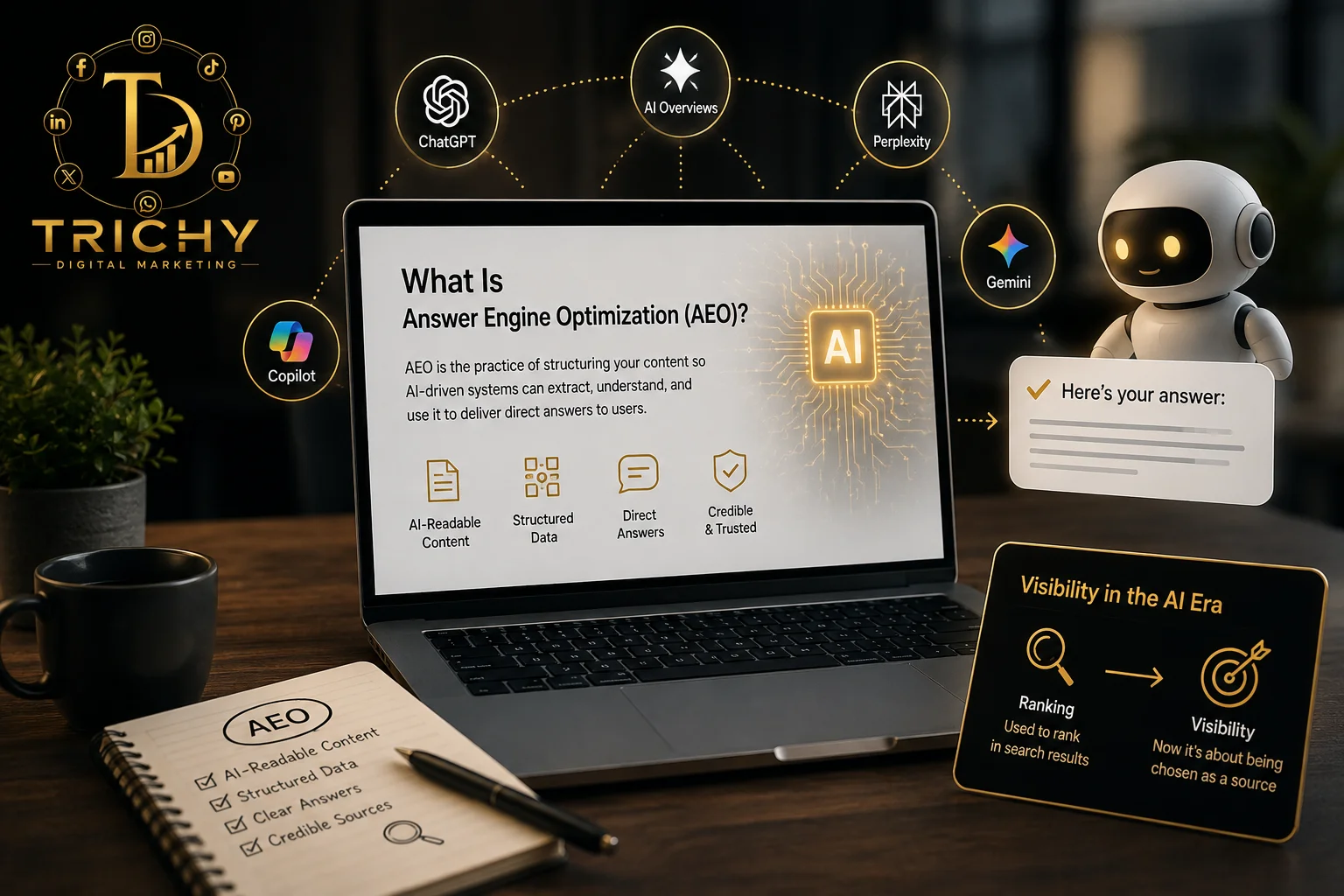
Answer Engine Optimization is the practice of structuring a website's content so that AI-driven answer systems — tools like ChatGPT, Perplexity, Google's AI Overviews and AI Mode, Gemini, and Microsoft Copilot — can extract it, understand it, and use it, with or without a citation, when generating a direct answer to a user's question.
That's a dense sentence, so it's worth unpacking slowly, because the mechanics matter more than the buzzword.
Traditional search engines have always worked the same basic way: a user types a query, the engine returns a ranked list of links, and the user decides what to click. The engine's job ends at the results page. Everything after that — reading the page, deciding whether it answers the question, deciding whether to trust it — is left to the human being doing the searching.
answer engines skip that handoff. Instead of returning a list of possible answers for a human to evaluate, they read across multiple sources themselves, synthesize a single response, and hand that response to the user directly. Sometimes a source link is attached to the answer. Sometimes it isn't. Either way, the user has already received what they came for before they ever reach a website.
For a business, that changes the entire meaning of the word "visibility." In the old model, visibility meant a position on a results page — ideally near the top, ideally with a compelling title and description that earned a click. In the new model, visibility means something closer to: does an AI system consider your business a credible enough source to draw from when it's answering a question that's relevant to what you do? You're no longer only competing for position. You're competing to be one of a small number of sources an AI system chooses to read, synthesize, and sometimes quote — or to not be used at all, regardless of how well you'd have ranked in a traditional list.
Traditional SEO vs AEO
The difference between traditional SEO and Answer Engine Optimization isn't just about ranking — it's about how your content is consumed. Here's a side-by-side look at how they compare.
| Factor | Traditional SEO | Answer Engine Optimization (AEO) |
|---|---|---|
| Primary Goal | Rank high on SERPs | Be cited as a source in AI answers |
| User Interaction | User clicks through to website | Answer is delivered directly to user |
| Content Structure | Keywords, backlinks, meta tags | Structured data, Q&A, clear hierarchy |
| Measurement | Impressions, clicks, bounce rate | Citations, share of voice in AI responses |
Why AEO Matters Right Now
Answer Engine Optimization isn't a future trend — it's already changing how users find information. Here's why you need to adapt today.
Zero-Click Searches Are Rising
A growing number of searches now end without a click, as AI-generated summaries provide instant answers directly on the search results page.
You're Competing for AI Trust
It's no longer enough to rank high — you must be seen as a credible, structured source that AI systems can confidently pull information from.
Optimize Now or Get Left Behind
Early adopters of AEO are already seeing higher visibility in AI answers. The time to structure your content for answer engines is now.
AEO vs SEO vs GEO — And Why the Distinction Isn't Fully Settled Yet
You'll see Answer Engine Optimization services in Trichy, AI Search Optimization, and Generative Engine Optimization services in Trichy used almost interchangeably on some websites, and treated as three entirely separate disciplines on others. Because this is such a young field, the industry hasn't fully standardized what each one means, and you should treat any agency that speaks about these terms with total, unqualified confidence with a healthy amount of skepticism.
| Traditional SEO | AEO | GEO | |
|---|---|---|---|
| Goal | Rank on the search results page | Be selected as the direct answer | Be understood, cited, and represented accurately across AI systems generally |
| Success looks like | A click from a ranked listing | Your content quoted or summarized in an AI answer | Consistent, accurate representation of your brand whenever an AI model discusses your category |
| Primary lever | Backlinks, on-page relevance, technical SEO | Clear, extractable, question-answering content structure | Entity consistency, structured data, third-party mentions, brand clarity across the web |
| User behavior | Browses and chooses a link | Reads the answer, may or may not click through | Same, but the "answer" may synthesize several brands at once |
In practice, these three disciplines are not competing strategies you have to choose between. They build on each other, in roughly the order listed above.
Strong technical and on-page SEO is still what gets your site crawled, indexed, and considered a credible enough source to be included in the pool of candidates an answer engine might draw from in the first place. Skip this step, and nothing downstream matters, because your content is never even in the running.
AEO adds a specific kind of structure and clarity on top of that SEO foundation, so that when an answer engine has already decided your page is a plausible source, it can actually lift a clean, specific, well-supported answer from it — rather than being forced to infer an answer from paragraphs that were written for a different purpose.
GEO extends the same underlying discipline outward, across the wider set of sources an AI model might draw on when forming an opinion about your business or your category — directories, review sites, other websites that mention you, and third-party content you don't directly control. The same principles apply: clear entities, consistent facts, credible mentions. But the scope is broader than your own website.
For most Trichy businesses considering AEO services in Trichy for the first time, the practical starting point is the same regardless of which of these three labels you use to describe the work. Get the fundamentals of SEO andcontent clarityright first. Then layer on the structure and consistency signals that make your content easier for AI systems specifically to extract, trust, and cite.
Why This Matters for Businesses in Trichy Now
Two things are happening at the same time, and together they create a window that won't stay open forever.
Local Research Is Moving Into AI Chat
Buyers researching a Trichy-based hospital, a Trichy college or coaching center, a manufacturer, a real estate developer, a hotel, or a retailer are increasingly starting that research inside an AI chat interface or an AI-generated search summary, rather than working through a traditional list of blue links. This isn't unique to Trichy — it's a pattern showing up across urban and semi-urban India, and globally — but it applies just as much to a local service business here as it does to a national brand.
Low Competition for AI-Cited Visibility, For Now
Most local businesses in and around Trichy have not touched AEO yet. Many haven't even heard the term. That means the competitive field for AI-cited visibility in a lot of local categories — healthcare, education, real estate, manufacturing, hospitality, and professional services among them — is still relatively uncrowded compared to how competitive traditional organic search has become in those same categories.
That combination — rising AI-first research behavior, paired with low current competition for AI-cited visibility — is exactly the kind of window that tends to close as more agencies and businesses catch on. It's not a permanent advantage. It's a temporary one, available to businesses that act on it early and honestly.
That said, we want to be direct about the limits here, the same way we're direct about limits throughout this page. AEO is a newer discipline than SEO. Industry practices are still evolving, sometimes month to month. No agency — including ours — has years of proven, AEO-specific track record, because the discipline itself has only existed as a distinct, named practice for a short time. Anyone claiming otherwise is either exaggerating or confusing general SEO results with AEO-specific ones.
What we do have is five years of SEO and content marketing work for businesses across Trichy — technical SEO, content structure, Google Business Profile management, and local entity consistency. That foundation is the same foundation AEO is built on. We're applying existing, demonstrated expertise to a newer set of platforms and a newer set of ranking signals, not claiming a separate, unrelated specialism we invented overnight to capture search demand for a trending keyword.
How Answer Engines Actually Decide What to Use
Before getting into what we actually do, it's worth explaining the mechanics behind AI answer generation, because understanding the mechanics is what separates a realistic AEO strategy from a superstitious one. Most AI answer systems work in some version of what's called a retrieve-then-generate process: first a set of candidate sources is retrieved, then a language model reads those sources and generates a synthesized answer.
Clarity and Structure
A page that states a direct answer near the relevant heading is far easier for a retrieval system to extract from cleanly than a page that requires the reader — human or machine — to infer the answer from several paragraphs of surrounding context. This is the single biggest lever most businesses can pull immediately.
Topical Depth
Pages that cover a subject thoroughly, addressing the natural follow-up questions a reader would have, tend to be treated as more reliable, more complete references than pages that touch a topic superficially and move on.
Freshness
Particularly for commercial and evaluation-stage questions, recently updated content tends to be favored over content that hasn't been touched in a long time. A page that was accurate two years ago but hasn't been reviewed since is a real risk, not a minor housekeeping issue.
Consistency and Credibility
Clear authorship, accurate business information, and consistent facts across multiple independent sources all contribute to how much an AI system appears willing to rely on a given page or business as a source.
Existing SEO Strength
Research from multiple industry sources suggests AI-generated answers often draw disproportionately from pages that already rank well organically. Strong traditional SEO remains a meaningful advantage for AI visibility too.
No single one of these factors guarantees inclusion in an AI-generated answer, and each platform appears to weigh them somewhat differently, in ways that aren't fully disclosed and that we can't independently verify with certainty. Our approach is to optimize for the pattern that shows up consistently across platforms, rather than trying to game any one system's current, likely-temporary behavior.
Platforms We Consider
Different answer engines behave differently, and it's worth being specific about which ones we're actually optimizing for, rather than speaking about "AI search" as one undifferentiated thing.
Google AI Overviews & AI Mode
Synthesized answers shown directly inside Google Search, drawing heavily on pages that also perform well in traditional organic search — one more reason AEO and SEO aren't really separate tracks in practice.
ChatGPT & Perplexity
Retrieval-based answer engines that actively cite web sources inline, often with visible links. These are the platforms where you're most likely to directly observe whether your content is being picked up.
Gemini & Microsoft Copilot
Increasingly integrated into everyday search and productivity tools professionals already use daily, with retrieval behavior that overlaps with, but isn't identical to, the platforms above.
We don't claim equal influence over all of these platforms, and we'd be lying if we said otherwise. Each one has different, largely undisclosed selection logic, and public confirmation of exactly what any of them use as ranking signals — including newer, still-unofficial proposals like the llms.txt file some websites have started publishing — is limited. Where a specific technique is speculative rather than confirmed by credible evidence, we'll tell you that plainly, rather than presenting a guess as an established best practice.
What Makes Content "Answer-Ready"
Before describing our specific services, it's worth being precise about what "answer-ready" content actually looks like in practice, because the phrase gets used loosely in a lot of marketing material without ever being defined.
The Question Comes First, Stated Plainly
A genuinely answer-ready page states the question it's addressing in language a real customer would actually use, not internal jargon. "How much does a root canal cost in Trichy" reads very differently from "Endodontic Treatment Pricing Overview" — even about the same topic.
The Answer Appears Immediately, Not Several Paragraphs Later
A common pattern on older-style service pages is a long block of brand introduction before ever getting to the answer. Answer-ready content flips that order — direct answer first, supporting nuance afterward.
The Answer Is Complete on Its Own
If a customer asks "what areas do you service," the answer shouldn't require cross-referencing a separate map graphic or a scattered list buried three sections down. A retrieval system pulling a snippet needs that snippet to stand alone.
Specific Numbers, Timeframes, and Details
Vague language like "affordable pricing" or "fast turnaround" gives an answer engine nothing concrete to extract or cite. Real numbers, ranges, or timeframes materially improve usability for both machines and people.
Claims Are Supported, Not Just Asserted
"We're the most experienced provider in Trichy" is an assertion with nothing behind it. "We've completed over [X] projects across Trichy since [year]" gives a verifiable claim to work with instead.
Written for One Primary Audience at a Time
Trying to target crawlers, AI answer engines, and human readers all at once in one paragraph tends to serve none of them well. Answer-ready content is written for the human first, with structure applied on top.
We use this framework as a practical checklist when reviewing and rewriting pages, rather than as an abstract principle we mention once and then set aside.
Technical Foundations We Check First
A significant amount of AEO work is invisible to a casual visitor, because it happens at the technical level. Before recommending any content changes, we check a set of technical fundamentals that determine whether an answer engine can even access your content in the first place.
Crawlability
Some AI crawlers behave differently from Googlebot. We check robots.txt configuration, server response behavior, and whether JavaScript-heavy pages render content accessibly.
Page Speed & Core Web Vitals
Slow-loading pages remain a real barrier to both indexing and user experience — a baseline requirement, not an optional extra.
Mobile Usability
A large share of local search activity in and around Trichy happens on mobile devices; poor mobile rendering hurts regardless of content structure.
Site Architecture & Internal Linking
How your pages link to each other affects how easily both search engines and answer engines understand which pages are authoritative on which topics.
Existing Indexing Status
We check whether your key pages are actually indexed by Google, since an unindexed page has effectively no chance of being surfaced in an AI-generated answer.
Only once these fundamentals are confirmed to be in reasonable shape do we move on to the content and structure work described below — building answer-ready content on top of a technically broken foundation tends to produce very little return.
Our AEO Services in Trichy
As an AEO company in Trichy, we approach this work as a layer on top of our existing SEO and content marketing services, not as a completely separate offering with its own detached pricing sheet and its own detached team. Depending on where your business currently stands, the following components typically make up an engagement.
AI Search Visibility Audit
Before we change anything on your website, we review how your current content is structured, whether it answers the real questions your customers are actually asking, and how your business is currently represented across Google Business Profile, relevant directories, and any existing schema markup on your site. This audit produces a clear, prioritized picture of what's already working, what's missing entirely, and what needs restructuring.
Answer-First Content Structuring
In our experience reviewing dozens of local business websites, the problem usually isn't a lack of information — it's that the actual answer is buried under paragraphs of introduction, or scattered across the page. We restructure and rewrite key pages so that specific, naturally phrased questions are followed by clear, direct, well-supported answers, while keeping the page genuinely pleasant for a human reader.
Structured Data & Schema Implementation
We implement schema markup — including Organization, LocalBusiness, Service, WebPage, and BreadcrumbList JSON-LD — matched exactly to what's visible on the page. Note: Google retired FAQ rich results from Google Search entirely as of May 7, 2026. FAQPage schema is still valid and still read by other systems, including some AI crawlers, but no longer produces a visible rich result inside Google Search itself.
Entity & Local Consistency Optimization
AI systems appear to build confidence in a business by cross-checking the same core facts — name, address, phone number, services, service area — across your website, Google Business Profile, directories, and other mentions online. We check and align these details across every property we manage, and flag inconsistencies elsewhere.
AEO Content Production
Using the same content marketing capability we already apply across our client base, we produce new content built around the real questions your actual customers ask — the kind of questions people genuinely type into ChatGPT or ask a voice assistant — rather than content built purely around a keyword list.
Ongoing Monitoring & Content Freshness
Answer engines appear to lean toward content that's current, particularly for commercial and comparison-type queries. We review and refresh key pages on a regular cycle, rather than treating AEO as a one-time project.
Our AEO Process
We apply the same underlying process we use across all of our digital marketing services, adapted specifically for answer-engine visibility work.
Discover
We start by understanding your business, your existing services, your current content, and how you currently show up — or don't — across both traditional search and AI answers. This includes running a set of realistic queries across the major platforms.
Research
We identify the real questions your customers ask, drawing on your team's frontline knowledge as well as keyword and query research, and audit your current schema and content structure.
Strategize
We prioritize which pages and topics to restructure first, based on commercial value and how large the gap is between current content and an answer-ready version.
Create
We rewrite and restructure priority content, build or correct schema markup, and align business information across your web presence, page by page.
Execute
We publish the changes, submit updated sitemaps, and make sure the technical fundamentals support crawlability by both traditional search engines and AI-specific crawlers.
Optimize & Scale
We monitor which content gets picked up in AI-generated answers where that's observable, refresh aging pages before they go stale, and expand the approach over time.
This isn't a one-time checklist we run through once and hand off. It's closer to an ongoing discipline, the same way SEO itself is an ongoing discipline rather than a task with a finish line.
A Realistic Starting Scope: The First 90 Days
Because AEO can sound abstract until you see it applied, here's what a typical first three months looks like for a mid-sized Trichy business — say, a healthcare provider or a manufacturer with an existing website and some prior SEO work already in place.
Discovery & Audit
We review the existing site structure, run realistic customer queries across ChatGPT, Perplexity, and Google to see what currently surfaces, and produce a written audit covering technical fundamentals, content gaps, schema status, and entity consistency.
Strategy & Prioritization
We identify the five to ten pages likely to deliver the most value if restructured first, and correct any glaring entity inconsistencies found during the audit — quick to fix, with outsized effect.
Content & Schema Work
We restructure and rewrite the prioritized pages using the answer-ready framework, and implement or correct schema markup to match. New content is drafted where a gap exists.
Execution & Monitoring
We publish remaining changes, submit updated sitemaps, confirm indexing, and begin a monitoring routine — testing the same queries used during the audit to see whether anything has shifted.
At the end of this window, you should have a clear, documented picture of what's changed, what hasn't yet, and what the next quarter's priorities should be — rather than a vague sense that "some AEO work happened" without any way to evaluate it.
AEO for Local Trichy Businesses
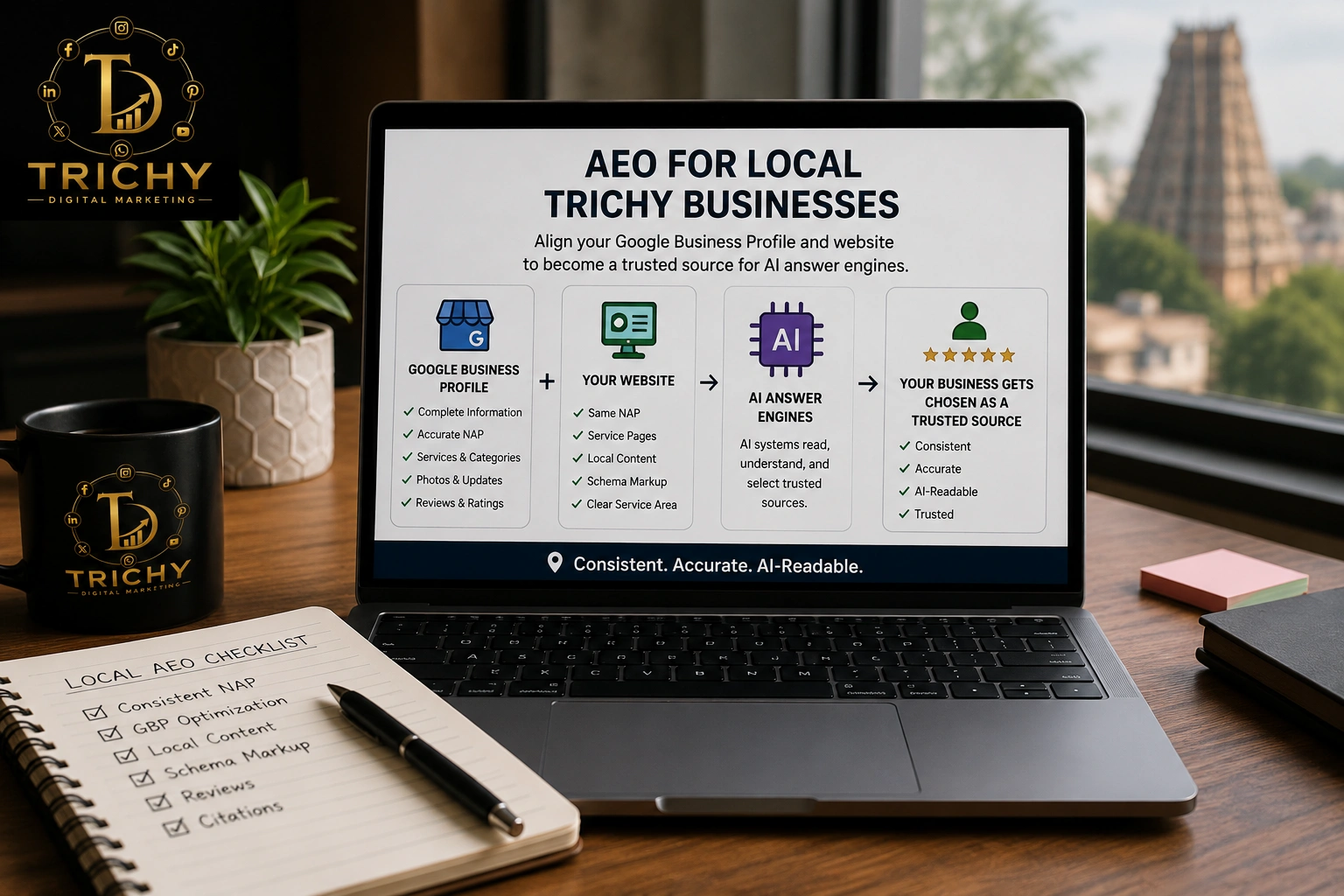
For a Trichy-based business specifically, local AEO mostly comes down to two things working together in sync: your Google Business Profile being complete and accurate, and your website's content and schema saying exactly the same thing about your business — name, address, phone number, services, and service area — as your profile does. Any gap between those two sources creates exactly the kind of inconsistency signal that reduces how confidently an AI system relies on you.
AI systems answering local questions — something like "a good [service] in Trichy," or "options near Cantonment," or a comparison-style question about two or three local providers — appear to lean heavily on this kind of structured, verifiable local data, alongside genuine third-party mentions and reviews from sources the business itself doesn't control.
We don't have, and won't invent, Trichy-specific data on exactly how often local AI searches happen, or exactly which business categories are most affected by this shift, because no reliable, publicly available local dataset like that currently exists for a city the size of Trichy. Anyone who tells you they have precise local numbers for this is either working from a much larger, unrelated dataset and presenting it as local, or simply making the numbers up. What we can offer instead is the same disciplined, verifiable approach we already use for Google Business Profile optimization and local SEO, extended to include the additional structure that makes content AI-readable.
Industries We Work With in Trichy
While the underlying AEO principles are the same across industries, the specific questions customers ask, and the specific consistency risks a business faces, vary a fair amount by sector. A few examples of how this plays out locally:
Healthcare Providers
Hospitals, clinics, and specialistsFace questions like "which hospital in Trichy treats [condition]." Accuracy and up-to-date information carry particular weight given the sensitivity of the topic.
Educational Institutions
Colleges, schools, and coaching centersFace comparison-style questions on courses, admissions, fees, and placements — where AI systems appear to favor freshness most heavily.
Manufacturers & Industrial
B2B businessesB2B buyers are often further along in a purchasing decision, so content that matters most tends to be specific and technical — capacity, certifications, materials, past work.
Real Estate Developers
Property and constructionHighly local and comparative queries. Consistency between listing details on your own site and third-party property portals matters a great deal.
Hotels & Hospitality
Accommodation and travelImmediate and practical queries — availability, amenities, proximity to landmarks. Freshness and accuracy of practical details carry particular weight.
Retailers & Service Businesses
Shops and local servicesThe biggest single win is often simply getting basic entity consistency right across the website, Google Business Profile, and directories.
Professional Services
Law, accounting, consultingFace nuanced, context-dependent questions, which makes generic content less useful than content built around real client conversations.
Restaurants & Food Businesses
Dining and food servicesImmediate, practical queries — cuisine, dietary accommodation, hours, delivery. Consistency across listing platforms matters more than almost any other category.
We tailor the specific questions we build content around, and the specific consistency checks we run, to whichever of these categories — or others — your business falls into, rather than applying an identical template across every client regardless of industry.
Page Types & Content Formats We Prioritize
Not every page on a website carries equal weight for AEO purposes, and part of our prioritization process is deciding which formats deserve attention first.
Service & Location Pages
Carry the most direct commercial value and are usually the first priority — the pages most likely to answer exactly the kind of question a local AI query is trying to resolve.
Comparison & Decision-Support Content
Pages that honestly compare options or walk through "how to choose" a provider tend to perform particularly well, since they match the structure of evaluation-stage questions.
FAQ Sections
Even with Google's FAQ rich results gone, FAQ-formatted content remains one of the clearest, most directly extractable formats available.
Pricing & Cost Pages
Pages that give honest ranges or starting points tend to perform disproportionately well for commercial questions AI systems are frequently asked.
Blog & Educational Content
Builds topical depth and demonstrates genuine expertise, contributing to broader credibility signals even when a specific post isn't the one cited directly.
About & Credibility Pages
Contribute to the entity-level trust signals that appear to matter for AI systems judging whether a source is credible.
We don't treat every page type as equally urgent for every client — the right starting point depends heavily on which of these formats are missing, thin, or already reasonably strong on your specific site, which is exactly what the initial audit is designed to identify.
A Note on AEO and Voice Search
Voice assistants — on phones, smart speakers, and in-car systems — rely on many of the same underlying mechanics described throughout this page, since a voice query typically triggers a retrieval-and-generation process similar to a text-based answer engine, just delivered as spoken output instead of written text.
Because a spoken answer has to be even more concise than a written one, the content characteristics that matter most for voice — direct, complete answers stated in a single clear sentence or two — overlap heavily with the answer-ready framework described earlier, rather than requiring an entirely separate strategy. We don't treat voice search as a distinct service line with its own separate pricing, because content well-structured for AI answer engines in general tends to perform reasonably well for voice queries too.
That said, we're cautious about making specific claims regarding voice search volume or behavior in Trichy specifically, for the same reason we're cautious about local AI search statistics more broadly — reliable, publicly available local data at that level of granularity doesn't currently exist, and we won't present a guess as though it were a verified figure.
A Realistic View of Where This Field Is Headed
We'd rather end this page with honesty than with hype, since hype is exactly what got AEO a reputation for being an overpromised, poorly explained service in the first place.
AI answer engines are genuinely changing how a meaningful share of people research decisions, including local decisions in a city like Trichy. That much is well-supported by the industry data referenced throughout this page, even accounting for the uncertainty in exact figures. What isn't yet well-established is a fixed, permanent playbook for how to reliably win visibility within these systems — because the systems themselves are still changing, sometimes significantly, on a timeline measured in months rather than years.
Given that, the most defensible approach isn't to chase every new tactic or platform-specific trick as it appears. It's to build on fundamentals that have held up across multiple platforms and multiple years of change already — clear, honest, well-structured content; consistent, verifiable business information; and genuine topical depth — and to stay current on what's confirmed versus speculative as the field continues to develop. That's the approach this page describes, and it's the approach we bring to every AEO engagement we take on for a business in Trichy.
What Affects AEO Timelines and Cost
There's no fixed, universal price for AEO work, and we'd encourage you to treat any provider quoting an exact number before actually reviewing your site with a healthy amount of caution — it's simply not possible to know the real scope of the work without first looking at what already exists. The actual scope of an engagement depends on several factors specific to your business:
As with SEO, results here are not immediate, and we won't pretend otherwise to make a sale. Because AI answer systems retrain, re-crawl, and update their retrieval sources on schedules that are different from — and often less predictable than — Google's traditional index, timelines for AEO can be genuinely harder to forecast than typical SEO timelines. No agency, including ours, can honestly commit to a fixed date by which your business will start appearing in AI-generated answers, and we'd be skeptical of any agency that does make that commitment.
How We Measure AEO Progress
Because most AI answer engines don't offer anything resembling the analytics dashboards businesses are used to from Google Search Console, measuring AEO progress requires a different, more manual approach than measuring traditional SEO progress.
Query Testing
We maintain a running list of realistic customer questions and test them periodically across ChatGPT, Perplexity, and Google's AI features, noting whether and how your business appears — currently the most reliable way to observe real-world behavior.
Referral Traffic Patterns
Where an answer engine does link back to your site, that traffic sometimes shows up under referral sources tied to AI platforms — though a meaningful share of AI-driven visibility never generates a click at all.
Underlying SEO Metrics
Because AEO and SEO share so much of the same foundation, continued improvement in traditional rankings and organic visibility remains a reliable proxy indicator that the underlying work is on track.
Entity Consistency Audits
We periodically re-check name, address, phone number, and service consistency across your web presence, since this tends to drift over time as directories update independently.
We report on all of this in plain language, showing you exactly what we tested and what we found, rather than presenting a polished dashboard built around metrics that don't actually reflect how these systems work.
Common AEO Mistakes
We see the same handful of mistakes repeatedly, both from businesses attempting AEO on their own and from other agencies offering AEO services in Trichy and elsewhere. It's worth naming them directly.
Treating It as a Replacement for SEO
Weak technical SEO and thin content undermine AEO before it even has a chance to work — the two are not separate tracks running in parallel.
Chasing Schema Without Matching Content
Structured data describing information not actually shown on the page violates search engine guidelines and can backfire into penalties.
Writing for Keywords Instead of Real Questions
A page can be keyword-optimized and still fail to get picked up by an answer engine if it never actually answers anything directly.
Letting Content Go Stale
A page that got cited once can lose that citation over time if it isn't kept current, particularly for commercial or comparison-type topics.
Inconsistent Business Details Across the Web
Mismatched names, addresses, phone numbers, or descriptions reduce how confidently an AI system can rely on you as a source.
Expecting Guaranteed or Fast Results
Nobody — including us — can promise a specific ranking, citation, or timeline in a system whose selection criteria change without warning.
How to Choose an AEO Company in Trichy
Since this is such a new field, the honest way to evaluate a provider isn't to ask them whether they "do AEO." Almost every agency will say yes regardless of whether they actually understand the mechanics. Instead, ask questions that separate genuine capability from repackaged marketing language:
If a provider — including us — can't answer these questions clearly and specifically, that's a meaningful signal worth paying attention to.
A Short Glossary of AEO Terms
Given how new and inconsistently used a lot of this terminology still is, a brief glossary is more useful than another paragraph of prose. These are the terms you're most likely to encounter, defined the way we use them on this page.
Answer Engine
Any AI system that generates a direct, synthesized response to a user's question rather than returning a list of links. ChatGPT, Perplexity, and Google's AI Overviews all fall under this definition.
Retrieval
The step in which an AI system searches for and gathers candidate sources relevant to a question, before a language model reads them and generates a response.
Extraction
The process of an AI system pulling a specific, usable piece of information out of a page's content. A well-written page can still extract poorly if answers aren't stated clearly.
Entity
A business, person, product, or place that a search or AI system can recognize as a distinct, identifiable thing, typically via consistent facts across multiple sources.
Entity Consistency
The degree to which facts about an entity match across every place it's mentioned online. Low consistency reduces confidence; high consistency increases it.
Schema Markup / Structured Data
Code added to a webpage, usually JSON-LD, that explicitly labels what different pieces of content mean, so machines can parse them directly.
Citation
In an AI-generated answer, a direct reference or link back to the source a claim was drawn from. Not all answer engines provide citations for every claim.
Freshness Signal
Indicators — last updated date, content changes over time — that a system uses to judge how current a piece of content is.
llms.txt
A proposed, currently unofficial file format some websites publish to give AI systems a structured summary of a site's content. Not a confirmed or universally adopted standard.
What You Can Check Yourself Right Now
Before engaging any AEO company in Trichy — including us — there are a handful of things you can check on your own website in under half an hour, simply to understand roughly where you're starting from.
Ask ChatGPT or Perplexity a Realistic Question
Phrase it the way a real customer would, about your own business or category. Note whether your business comes up, whether the information is accurate, and whether a source link is provided. Try three or four different questions, since results vary by phrasing.
Search Your Business Name Plus "Trichy"
Check whether the details match across the first several results — your own website, Google Business Profile, and any directory listings. Look for mismatched phone numbers, outdated addresses, or inconsistent service descriptions.
Time How Long It Takes to Find the Answer
Open your three or four most important pages. If you, already knowing the answer, have to scroll or read several paragraphs before reaching it, an unfamiliar reader — or an AI system — will struggle even more.
Check When Key Pages Were Last Meaningfully Updated
Not just republished with a changed date. If the substantive content hasn't changed in over a year, that's a reasonable candidate for a refresh regardless of anything else.
None of this requires specialized tools, and doing it yourself first will make any conversation with an AEO provider — including a conversation with us — considerably more productive, since you'll already have a rough sense of where the real gaps are.
Why Businesses in Trichy Choose to Work With Us
We're not going to claim a track record we don't have in a field this new. What we can point to honestly is five years of SEO and content marketing work for businesses across Trichy, spanning technical SEO, on-page content strategy, Google Business Profile management, and local entity consistency work — the same underlying skill set AEO is built on top of.
We approach AEO the same way we approach everything else: as a discipline that requires ongoing attention rather than a one-time fix, with realistic expectations set from the very first conversation rather than after the contract is signed. If a technique is speculative rather than confirmed, we'll say so. If a platform's behavior is genuinely unpredictable, we'll say that too. Our aim is for you to understand exactly what you're paying for, exactly what it can realistically achieve, and exactly what it can't.
Ready to Talk About AEO for Your Business?
If you'd like an honest look at where your website currently stands — for traditional search and for AI answer engines — as an AI search optimization company in Trichy, we're happy to walk through it with you directly. We'll tell you what's genuinely worth doing now, what's still speculative and not yet worth spending on, and what a realistic starting scope looks like for a business in your specific situation.
Trichy Digital Marketing
77, C5, St. Pauls Complex, Pudukottai Main Rd, Cantonment, Trichy 620001
Phone: 93848 19143 · Email: info@trichydigitalmarketing.com
Frequently Asked Questions About AEO in Trichy
-
Answer Engine Optimization (AEO) is the practice of structuring website content so AI answer engines — ChatGPT, Perplexity, Google AI Overviews, Gemini, and similar tools — can extract, understand, and use it when generating a direct answer to a user's question, rather than simply linking to it.
-
Yes, but the two aren't separate tracks — AEO builds on SEO fundamentals. SEO focuses on ranking your page in search results; AEO focuses on structuring that same content so it can be pulled into an AI-generated answer. Strong technical and on-page SEO remains the foundation both depend on.
-
The industry hasn't fully standardized these terms yet. Generally, AEO is used to describe optimizing individual pieces of content to become the direct answer to a specific question, while Generative Engine Optimization describes the broader practice of making sure AI systems understand and represent your brand consistently and accurately across the whole web, not just your own site.
-
No. No agency can honestly guarantee inclusion in AI-generated answers, because none of these platforms publish their exact selection criteria, and all of them change frequently and without warning. We can commit to a transparent, defensible process — not a guaranteed outcome.
-
No. AEO adds structure and clarity on top of solid SEO; it doesn't substitute for it. A site with weak technical SEO or thin content is unlikely to perform well in AI answer engines either, regardless of how good its schema markup is.
-
FAQPage structured data is still a valid schema type and is still read by systems other than Google's rich-result display — including some AI crawlers — but as of May 7, 2026, it no longer produces a rich result in Google Search itself. We'll advise you honestly on where FAQ schema still adds real value versus where it's now cosmetic.
-
There's no fixed timeline. Because AI systems re-crawl and retrain on schedules that are different from Google's traditional search index, results can appear on a less predictable timeline than typical SEO improvements. We treat it as an ongoing process rather than a project with a fixed end date.
-
It's relevant for local businesses too, particularly through Google Business Profile accuracy and consistent business information across the web — both of which AI systems appear to rely on when answering local questions. There's currently no reliable local data on exactly how much AI search affects any specific Trichy business category, so we assess this case by case rather than assuming.
-
Cost depends on how much content needs restructuring, whether schema markup already exists, and whether you want ongoing monitoring or a one-time project. We provide a scoped estimate after reviewing your current site rather than quoting a fixed price upfront.
-
Our primary focus is on businesses based in and around Trichy, since local entity consistency and google business profile work are most effective when we have direct, practical familiarity with the local market. That said, the underlying AEO principles described throughout this page apply to businesses anywhere, and we're happy to discuss engagements outside Trichy on a case-by-case basis.
Areas We Serve in Trichy
Trichy Digital Marketing provides professional digital marketing, website development, SEO, Google Ads, social media marketing, branding, and software development services to businesses across Trichy and nearby areas. Whether you're a startup, small business, educational institution, healthcare provider, retailer, or large enterprise, our team delivers tailored digital solutions to help you increase online visibility, generate quality leads, and grow your business.